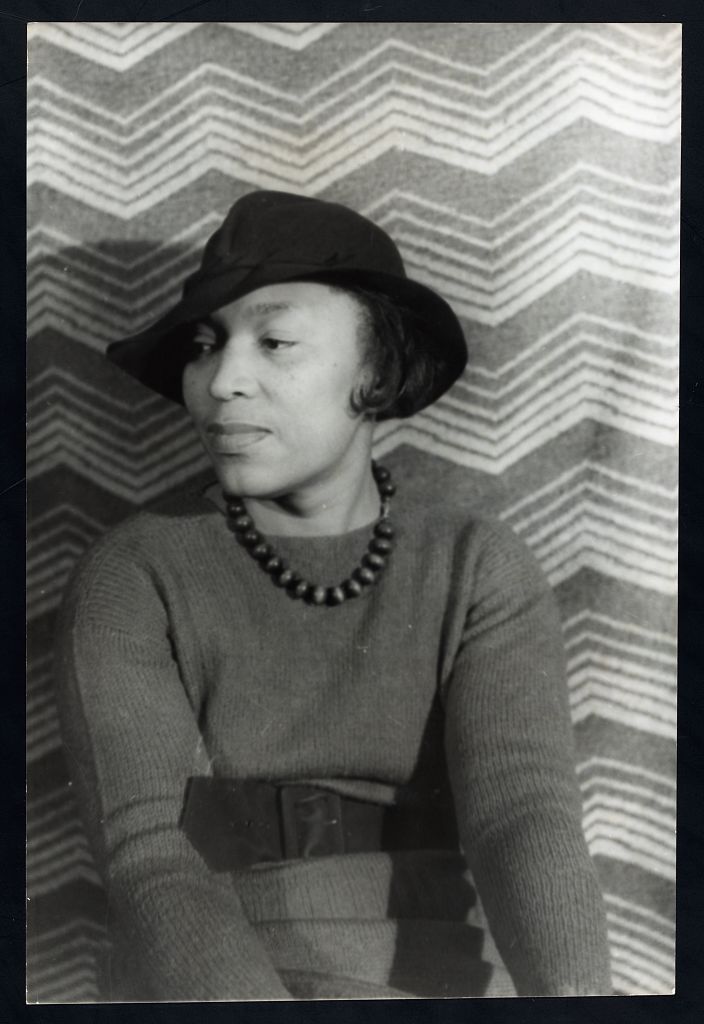
Zora Neale Hurston died on January 28, 1960, in Fort Pierce, Florida, in the St. Lucie County welfare home. She was sixty-nine. Her books were out of print, her name had fallen out of most anthologies, and she was buried in an unmarked grave in a segregated cemetery on the north side of town. Within a few years nobody could say exactly where the grave was. Thirteen years after the burial a young writer named Alice Walker came to Fort Pierce to look for it, and what she found, and did not find, began the recovery of one of the major American writers of the twentieth century.
Hurston came to Fort Pierce in 1957. This is what the years after held: the concrete-block house on School Court, the classroom at Lincoln Park Academy, the columns for the Fort Pierce Chronicle, the welfare home, the cemetery, and the stone that finally carried her name. The years before are told briefly, to explain how a writer of her standing arrived here with almost nothing.
Before Fort Pierce
Hurston was born on January 7, 1891, in Notasulga, Alabama, and raised in Eatonville, Florida, an incorporated all-Black town that she claimed all her life as her birthplace. Eatonville's front porches, where neighbors traded stories and argued philosophy, became the raw material of her fiction. Her mother, Lucy Ann Potts Hurston, died in 1904, when Zora was thirteen, and the years that followed were unsettled: relatives' houses, odd jobs, a stint as a wardrobe assistant with a traveling Gilbert and Sullivan company. She finished high school in Baltimore at twenty-six, entered Howard University in 1918, and in 1925 moved to New York, where she studied anthropology at Barnard College under Franz Boas.
Between 1927 and 1932 she collected folklore, songs and sermons in Black communities across Florida, Alabama, Louisiana and the Bahamas, and the fieldwork became Mules and Men (1935). Her first novel, Jonah's Gourd Vine (1934), drew on her parents' lives in Eatonville. Their Eyes Were Watching God followed in 1937, written in seven weeks while she was doing research in Haiti. It follows Janie Crawford through three marriages and a hurricane, and the storm in its closing chapters is the one Fort Pierce lived through in September 1928.
Tell My Horse (1938), Moses, Man of the Mountain (1939), her autobiography Dust Tracks on a Road (1942), which won the Anisfield-Wolf Book Award, and Seraph on the Suwanee (1948) completed the shelf.
The decline began in the late 1940s. Her politics set her apart from most of her peers: she opposed the Supreme Court's ruling in Brown v. Board of Education (1954), arguing that it implied Black institutions were inferior, and she refused to write the protest literature the critics of the day expected. By the early 1950s she was broke, her books were out of print, and the public had largely forgotten her.
1957: Zora Neale Hurston comes to Fort Pierce
Hurston arrived in Fort Pierce in 1957. She was sixty-six, in failing health and nearly destitute. She rented a small concrete-block house at 1734 School Court in Lincoln Park, the neighborhood whose main street, Avenue D, was the center of Black commercial and social life in the city. She filled the house with books and papers and kept writing.
Lincoln Park Academy and the Fort Pierce Chronicle
She found work as a substitute teacher at Lincoln Park Academy, the school for Black students, founded in 1922 and the educational center of the neighborhood. She also wrote for the Fort Pierce Chronicle, a weekly Black newspaper, and her columns ranged over local politics, community events and social commentary. And she was still at work on a book, a historical novel about Herod the Great. It was unfinished when she died.
Her health failed through these years. She suffered from hypertension and then a stroke, and she was admitted to the St. Lucie County welfare home. She died there on January 28, 1960.
The grave at the Garden of Heavenly Rest
The community collected money for the funeral, and Hurston was buried at the Garden of Heavenly Rest, a segregated Black cemetery on the north side of the city. No stone marked the grave. Within a few years its exact location was uncertain, lost under weeds and palmetto scrub in a cemetery that had gone largely untended. A writer whose novel would later be taught in classrooms across the country lay in an anonymous plot in a small Florida town, and for more than a decade almost no one came looking.
August 1973: Alice Walker and the gravestone
The recovery of Hurston's reputation began in that cemetery. In August 1973 the young writer Alice Walker, who had been reading Hurston and could not understand how such a writer had been allowed to disappear, traveled to Fort Pierce to find the grave. She searched the overgrown ground of the Garden of Heavenly Rest, could not fix the exact spot, and set a marker on the site she judged most likely. The stone calls Hurston “A Genius of the South,” names her novelist, folklorist and anthropologist, and gives her dates as 1901 to 1960. The birth year is the one Hurston herself usually claimed; she was born in 1891.
Walker wrote about the search in “In Search of Zora Neale Hurston,” published in Ms. magazine in 1975. The essay set off a wave of scholarly and popular interest. The University of Illinois Press reissued Their Eyes Were Watching God in 1978, and the novel became a fixture of American literature courses. Hurston is now read as a foundational figure in African American literature, in feminist thought and in American anthropology, and the recovery started with a marker over an approximate grave in Fort Pierce.
What Fort Pierce keeps
The house at 1734 School Court was placed on the National Register of Historic Places in 1991. The Zora Neale Hurston Dust Tracks Heritage Trail, named for her 1942 autobiography, is a self-guided route through the sites of her Fort Pierce years: the house, Lincoln Park Academy and the Garden of Heavenly Rest. The annual Zora Neale Hurston Festival of the Arts and Humanities is Eatonville's, held each January in the town she called home. Fort Pierce's part of the story is the last chapter, and the city has kept its places.
Lincoln Park's schools, churches and cemeteries, Lincoln Park Academy among them, belong to the wider history of Black life in St. Lucie County through the decades of segregation, and the Garden of Heavenly Rest is a reminder that segregation reached even the grave. For the storm that Hurston put into the novel she is best known for, read our account of the 1928 Okeechobee hurricane as Fort Pierce lived it. Her neighbor in these pages is Dan McCarty, the Fort Pierce grower who became governor of Florida and died in office in 1953.