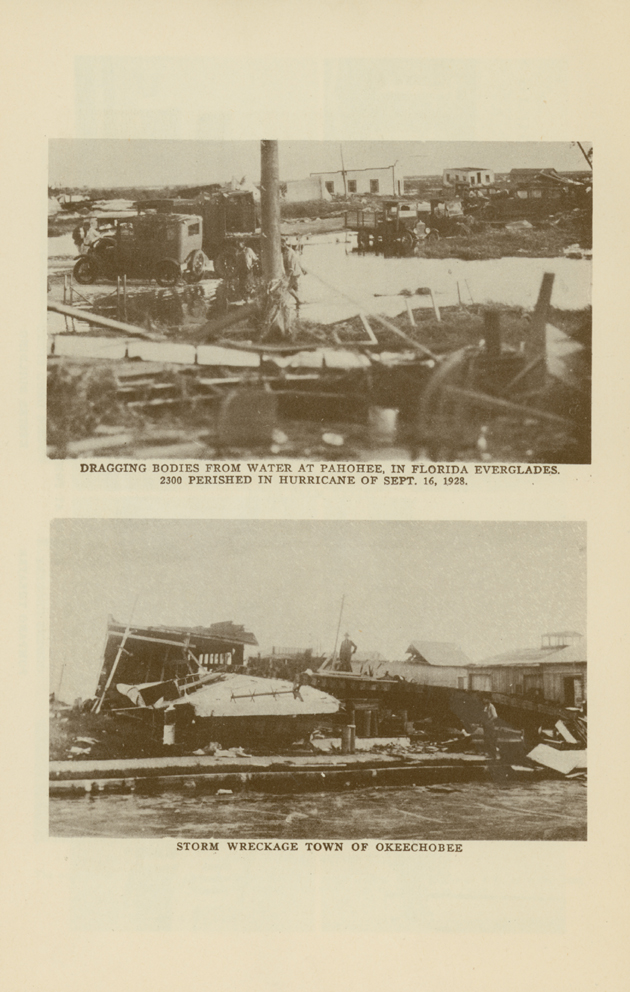
On the evening of Sunday, September 16, 1928, the center of the 1928 Okeechobee Hurricane crossed the Florida coast near West Palm Beach, about fifty miles south of Fort Pierce. The Weather Bureau called it one of the greatest hurricanes of record. From the coast it moved northwest across Lake Okeechobee in the first hours of the night, and about two thousand people drowned along the lake's southeast shore.
Fort Pierce was never inside the center. The town lay to the north of it as it came ashore, and to the north and east of it as it crossed the lake, inside the stretch of coast the Weather Bureau's Sunday warning singled out.
The warnings Fort Pierce received
The Weather Bureau had followed the storm since the morning of September 10, when a steamer about 600 miles east of Barbados sent the first report of it by radio. From the 11th the Bureau issued advisories twice a day, and they said repeatedly that this was a dangerous storm. It crossed the Leeward Islands on the 12th and Puerto Rico on the 13th, where many lives were lost, then held a course to the northwest at about fourteen and a half miles an hour.
On Saturday night, September 15, the advisory put the center near or a little north of Nassau by Sunday morning and said storm warnings were flying from Miami to Titusville, a stretch with Fort Pierce inside it. Winds of hurricane force were probable 60 miles off the southeast coast by Sunday noon, and there was no sign yet that the storm would curve away to the north. The messages to Miami and West Palm Beach asked that every precaution be taken that night in case hurricane warnings were needed on Sunday.
The center passed just north of Nassau early on Sunday. The observer there lost his anemometer cups at 96 miles an hour; his barometer bottomed at 28.08 inches at five in the morning, with the wind estimated at 110 to 120 miles an hour. No lives were lost at Nassau, probably, he wrote, because of the early warnings.
At 10:30 on Sunday morning the Weather Bureau ordered hurricane warnings hoisted from Miami to Daytona. The order went on: “No report this morning from Nassau. Indications are that hurricane center will reach the Florida coast near Jupiter early to-night. Emergency. Advise all interests. This hurricane is of wide extent and great severity. Every precaution should be taken against destructive winds and high tides on Florida east coast, especially West Palm Beach to Daytona.”
Fort Pierce sat inside that last stretch, from West Palm Beach to Daytona. The order came about eight and a half hours before the center reached the coast. The Bureau's Jacksonville office wrote afterward that all of its warnings had been correct and timely.
Sunday night: the center passes fifty miles south
The center reached the coast in the Palm Beach section at about seven that evening. A barograph in the telephone company's office at West Palm Beach recorded a pressure the Weather Bureau corrected to 27.43 inches, then the lowest ever recorded in the United States during a hurricane. The calm at the heart of the storm ran over a path 25 miles or more wide, nearly twice the width of the center of the Miami hurricane two years before.

From the coast the center moved northwest, inland and away from Fort Pierce. It crossed Lake Okeechobee in the early part of the night, was near Bartow by seven on Monday morning, and passed a short distance west of Jacksonville at about one o'clock on Tuesday morning.
Which side of a hurricane a town is on matters, and the Weather Bureau's account says why. Winds of hurricane force seldom reach more than a few miles to the south and west of a center, because the pressure falls away more gently there than it does to the north and northeast. Fort Pierce was to the north of the center when it came ashore, and to the north and east of it as it crossed the lake.
Hurricane damage in Fort Pierce: what the record shows
The Weather Bureau's account of the storm, dated October 31, had received no detailed report of damage along the east coast of Florida. What it had came from its Miami office, which described serious structural and water damage from Pompano north to Jupiter, worst at Palm Beach and West Palm Beach. It names no town north of Jupiter, and Fort Pierce is about forty miles farther up the coast.
It has no wind reading from Fort Pierce either. Of the regular Weather Bureau stations it lists, Miami recorded an extreme velocity of 78 miles an hour and Jacksonville 56. The section director at Jacksonville judged that 100 miles an hour or more had seemingly occurred at West Palm Beach, Palm Beach and Lake Worth, and that whole gale to hurricane winds prevailed over the southeast coast and inland that night.
The Red Cross announced its count on October 28: 1,836 dead and 1,870 injured in Florida. It listed the coast from Jupiter to Delray Beach separately, with 26 dead; the rest of Palm Beach County had 1,700, Broward County 1 and Okeechobee County 25. Every other part of Florida, St. Lucie County among them, was counted together at 84 dead and 67 injured. By the same date 10,172 families had applied to the Red Cross for aid, about two thirds of them in Palm Beach County.
The Miami office drew one lesson from this storm and the Miami hurricane of 1926 together: buildings properly built, frame as well as masonry, did not suffer serious structural damage, and storm shutters kept practically any damage from them.
At Lake Okeechobee
The worst of the storm fell along the lake's southeast shore. The wind drove the water south against the lake's low rim until it stood 10 to 15 feet high, and at Belle Glade, Pahokee and South Bay the small houses were washed away or flooded. About two thousand people drowned there, and practically the whole of the Everglades south of the lake went under water.
On the lake shore half a mile north of Canal Point, the observer at a government sugar cane breeding station lost his anemometer cups to a 75-mile wind at 8:15 that night. He estimated 150 miles an hour at nine, recorded a dead calm from 9:30 to 10 as the center passed over, and estimated 160 from the southeast at about 10:45.
The Miami office had telephoned the lake region that the storm would likely come inland near Jupiter and head toward Okeechobee, and so had Miami firms with interests along the south shore. Frank Schuster, at South Bay, told the Bureau several days later that the warning gave him time to make many trips by car “for the purpose of collecting the white residents and moving them to a large barge.” With the help of other men he saved 211 men, women and children.
Fort Pierce before and after 1928
The 1928 storm was not the first hurricane the town had met. In October 1910 a hurricane the Weather Bureau had warned of for five days came up the river at seventy miles an hour, wrecked the wharfs and boathouses on the Fort Pierce shore, and sent the Board of Trade to the Bureau for a flagstaff to fly its storm warnings. That story is told on the page for the hurricane of 1910.
Zora Neale Hurston set the closing chapters of her 1937 novel, Their Eyes Were Watching God, in this storm and the flood at the lake. She lived in Fort Pierce from 1957 until her death in 1960, and her years here are told on our Zora Neale Hurston page.
For the military history that would shape Fort Pierce fifteen years after the hurricane, read about WWII UDT training on Fort Pierce's beaches.
Sources
The storm's track, the warnings and the readings are from Charles L. Mitchell, “The West Indian Hurricane of September 10-20, 1928,” Monthly Weather Review 56, no. 9 (September 1928), pages 347 to 350, published by the U.S. Weather Bureau and held by the American Meteorological Society. The Red Cross count of October 28 is on page 350, where the Weather Bureau's San Juan report on the storm also begins. NOAA's National Hurricane Center keeps a scan of the Review's 1928 hurricane pages, the source of the barograph trace above.